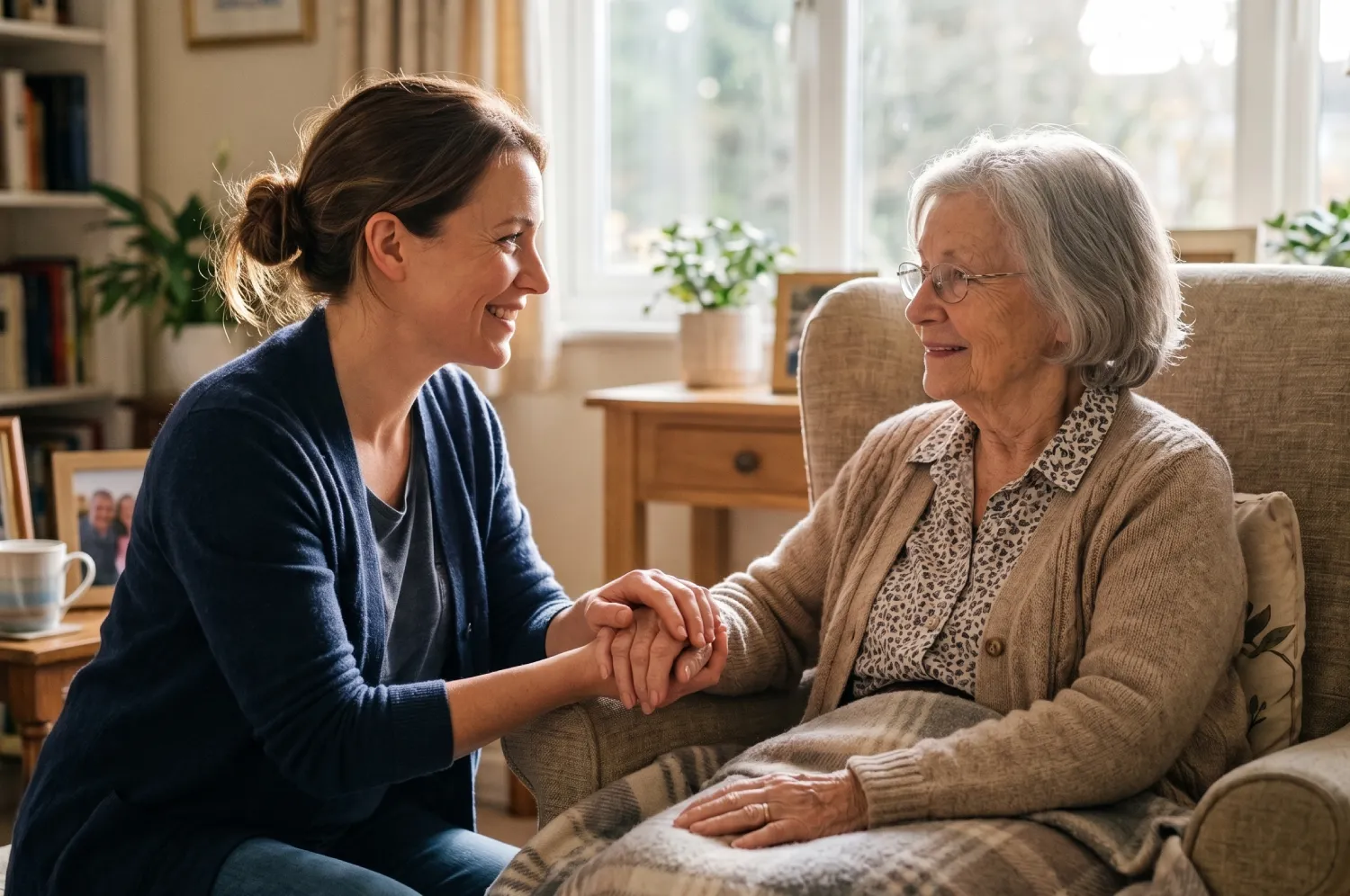
If you’re caring for someone living with dementia, chances are you’ve found yourself wondering “Why is my loved one pushing back on this?”
Maybe the struggle happens around taking a shower. Maybe it shows up when it’s time for medication. Sometimes it’s getting dressed, using the bathroom, eating a meal, or even walking from one room to another. You know the task needs to happen, yet the person you care about says “no,” becomes upset, resists your help, or seems to freeze halfway through.
Resistance and refusals are among the most common challenges in dementia care. They can also be some of the most frustrating. From a caregiver’s perspective, the need often feels obvious. Your loved needs a shower or needs to eat. Or he or she needs medication or assistance.
The challenge is that what feels obvious to us may not feel obvious to the person living with dementia.
Why People with Dementia Refuse Care
There are many reasons seniors with dementia may resist help or refuse care. In some cases, they feel embarrassed that they need assistance with tasks they once handled independently. In others, they feel anxious because they’ve lost a sense of control. Sometimes they simply don’t understand what’s being asked of them. Other times, they don’t understand why it’s being asked at all.
That last reason is more common than many caregivers realize.
I’ve heard caregivers say things like “I went in to help her shower, and she insisted she already showered.” Others tell me “I tried helping him get dressed, but he said he always dresses himself.” I’ve also heard “I made lunch, and she told me she had already eaten.”
The difficult part is that they may genuinely believe those things.
When seniors with dementia believe they already showered, being asked to shower again feels unreasonable. If I came home tonight and my husband told me I needed another shower, I would probably refuse too. I already showered today. From my perspective, there would be no reason to do it again.
That’s often the reality of dementia care. Their version of reality and ours are no longer aligned. When we push from our reality, they naturally push back from theirs.
Compassion Creates Cooperation
One phrase I often share when teaching caregivers is this: compassion equals compliance.
That doesn’t mean kindness magically solves every challenge. Dementia is still dementia. What it does mean is that the way we approach a situation has more influence than we sometimes realize.
Caregiving is exhausting. Frustration is normal, especially when you’re trying to help someone who clearly needs assistance and he or she continues refusing. In your mind, you may be thinking “You need a shower. You’re dirty. I’m trying to help you.” Meanwhile, your loved one may be experiencing something completely different. He or she may be thinking “Why are you treating me like I can’t do this? Why are you ordering me around? Why are you making me feel incapable?”
When we begin to see the situation from that perspective, our approach often changes.
One of the biggest mistakes caregivers make is moving too quickly. I often tell people “Too slow, can’t go.” Individuals living with dementia frequently cannot process information, movement, instructions, and expectations at the pace we would like. A multistep task can overwhelm a brain that’s already working hard to make sense of what’s happening, especially when we are speaking rapidly or physically rushing them.
What seems simple to us may feel incredibly complicated to them.
When the Hardest Part Happens at the End
Some of the most confusing moments for caregivers happen when their senior loves ones appear cooperative at first.
They follow along. They walk where they need to go. Everything seems to be progressing smoothly. Then, just when the final action is required, they stop.
I’ve spoken with caregivers who were helping someone use the bathroom. They successfully guided the person there. The senior made it into the bathroom. Everything seemed on track. Then, when it was time to sit down on the toilet, the person froze.
In many ways, that can feel more frustrating than an immediate refusal because you were so close. You thought your loved one understood. You believed the task was about to be completed. Instead, you may find yourself backing up, regrouping, and attempting the process several more times.
Often, this type of resistance isn’t intentional. It may indicate the person doesn’t fully understand what’s happening or doesn’t feel secure enough to continue. Seniors with dementia aren’t necessarily trying to make the situation difficult.
Sometimes they’re simply stuck.
Preventing the “No”
Another lesson I frequently teach is that avoiding the word “no” is often easier than overcoming it.
Once a person says “no,” turning that answer into “yes” becomes significantly harder. That’s true in dementia care, and honestly, it’s true for most people.
If you walk into a room and immediately say “You need to take a shower,” you may get an instant refusal. Once that “no” appears, people often dig in. Their position hardens. Their minds feel made up.
A better strategy is often to avoid leading with the demand itself.
Sometimes that means offering choices. Sometimes it means asking for help. Other times it means changing how the task is introduced. Rather than making seniors with dementia feel as though something is being done to them, we want them to feel included in the process.
Are We Focused on Their Needs or Ours?
Many refusals happen because caregivers are operating from their own agendas.
We need them dressed right now.
We need to leave for an appointment.
We need the shower finished before lunch.
We need them to eat because the food is ready.
Those concerns are valid. The problem is that they may not match where the person with dementia is mentally or emotionally at that moment.
I once shared the story of a woman who took an incredibly long time to button her sweater. Looking at the situation from the outside, it would have been easy to step in and finish the task for her. It certainly would have been faster.
But when we paid closer attention, we realized buttoning the sweater was the part she could still do independently. It was the part that allowed her to feel like she was dressing herself.
Instead of taking over completely, the caregiver assisted with the clothing underneath and allowed her to manage the sweater buttons. If you asked that woman whether she dressed herself, she would confidently say yes.
And honestly, she would be right.
She completed the part that mattered most to her.
This is the balance we should be searching for. Can we complete part of the task while preserving some independence? Can we provide support without taking away every opportunity for control?
People with Dementia Often Reflect the Emotions around Them
One reality of dementia care is that emotions are contagious.
When we enter a situation feeling rushed, irritated, anxious, or angry, the person living with dementia often reflects that energy right back to us.
During my years working in memory care, whenever a resident had a major outburst or refused care, one of my first questions for staff was “What did you do?”
Not because I assumed someone intentionally caused the problem but because people with dementia are frequently responding to something in their environment. It may be our tone of voice. It may be our body language. It may be our pace. It may simply be the way we approached them.
One caregiver told me he eventually realized he had to manage his own emotions before he could effectively care for his wife. When he became worked up, she became worked up. When he remained calm, she was far more likely to stay calm as well.
He developed a simple breathing practice. Before responding, he would press his thumb and pinky finger together and take a slow breath.
What he discovered was powerful.
Trying to control himself helped far more than trying to control her.
That’s easier said than done. Many times, the person with dementia forgets the disagreement within minutes, while the caregiver carries it for the rest of the evening. This is why taking a moment to reset yourself before entering a challenging situation can make such a difference.
Ask More, Tell Less
The way we phrase things matters.
“You have to get dressed” feels very different than “Can you help me get ready so we can go?”
“You need to eat this” creates a different reaction than “Would you try this for me?”
This is especially important when an adult child is caring for a parent.
In the parent’s mind, his or her role may still be to take care of you. When you suddenly begin directing your parent and telling him or her what to do, it can feel uncomfortable or even insulting. Your parent may feel as though you see him or her as a child.
I’ve watched daughters lovingly help their mothers get dressed, layering sweaters and scarves because they want them warm, comfortable, and safe. The daughter’s intentions are wonderful.
But from the mother’s perspective, she may be sitting there thinking her daughter believes she’s incapable of doing anything herself.
The task may still need to happen.
The approach is what changes everything.
Trained caregivers who have experience in communicating with seniors with dementia can be a fantastic resource for family members. If your senior loved one has been diagnosed with dementia and needs help with tasks like meal prep, transportation, medication reminders, bathing, and grooming, reach out to Assisting Hands Home Care, a leading provider of Columbus senior home care.
Simplify the Task before You Start
Sometimes the easiest way to reduce resistance is by preparing the environment ahead of time.
Imagine telling someone “Go into the bathroom, brush your teeth, and take your medicine.”
To most of us, that sounds straightforward.
For seniors living with dementia, those instructions may contain too many steps. They might walk into the bathroom and stop. Then the caregiver becomes frustrated because only the first instruction was completed.
If you already know you’ll need to guide your loved one through each step, it often helps to prepare in advance. Put the toothpaste on the toothbrush. Have the medication ready. Remove distractions. Make the environment as clear as possible.
When your loved one arrives, the process feels easier and less overwhelming.
The same principle applies to bathing.
If there are five different bottles in the shower, a person with dementia may squeeze product from every single one onto the washcloth. Eventually, reducing those choices to one bottle may be the better option. Later, you may place the soap directly on the washcloth. At another stage, you may hand your loved one the washcloth and guide him or her through each step individually.
The goal isn’t to take over prematurely.
The goal is to eliminate unnecessary confusion.
I’ve seen people squeeze A&D ointment onto a toothbrush because it looked enough like toothpaste. In memory care communities, we learned very quickly that leaving multiple similar-looking tubes available wasn’t always safe. When someone’s brain can no longer sort through those options effectively, the environment must take on part of that responsibility.
Living with dementia can make it difficult for seniors to manage everyday tasks on their own. Certain age-related conditions can make it more challenging for seniors to age in place safely and comfortably, but 24-hour home care experts are available around the clock to help Columbus seniors manage their health. At Assisting Hands Home Care, we take measures to help seniors prevent illness and injury by assisting with exercise and mobility, preparing nutritious meals, helping with bathing and other personal hygiene tasks, and much more.
Look beyond the Refusal
Sometimes resistance has very little to do with the task you’re trying to accomplish.
Instead, there may be an unmet need standing in the way.
The person may be hungry or thirsty. He or she may be cold, overheated, uncomfortable, overstimulated, or need to use the bathroom. Until that need is addressed, the person may not have the ability to focus on anything else.
Bathroom needs are a perfect example.
Seniors with dementia may not be able to tell you they need to go, but their bodies often communicate it anyway. They may fidget. They may rub their legs. They may shift repeatedly in their chairs. They may cross and uncross their legs or touch their bodies in ways that offer clues.
We notice these signs in young children all the time. We jokingly call it the “pee-pee dance.”
Adults can have their own version too.
If someone desperately needs the bathroom and we’re trying to get the individual to eat, take medication, or shower, his or her attention may be locked on to that unmet need. Until it’s resolved, cooperation may be difficult.
The same principle applies to light and temperature.
A bright room may cause seniors with dementia to squint, shield their eyes, or become agitated. If they’re cold, they may rub their arms, shuffle their feet, or fidget constantly. When they can no longer explain what’s bothering them, their behavior may become the only communication available to us.
The Value of Saying “I’m Sorry”
One of the most valuable skills caregivers can develop is learning to apologize, even when they know they did nothing wrong.
That isn’t easy.
In fact, it can be incredibly difficult.
Not long ago, I visited a family’s home to complete a home care assessment. The woman had dementia, and initially everything went well. I asked a few simple questions. She answered them. Her husband filled in some details.
Then, without warning, she became extremely upset.
She accused me of barging into her house, storming in uninvited, mocking her, and asking ridiculous questions.
None of those things had actually happened.
But they had happened in her reality.
She felt threatened. She didn’t understand why I was there. As I spoke with her husband and asked questions, I stopped feeling like a friendly visitor and started feeling unsafe to her.
So I apologized.
I told her I was sorry. I said I should have asked permission. I acknowledged that I had made her feel uncomfortable.
Her husband looked at me as if to say “You didn’t do anything wrong.”
But I also knew that arguing facts would accomplish nothing.
Had I responded with “I didn’t barge in. Your husband invited me. I only asked a handful of questions,” we likely would have gone back and forth endlessly.
Instead, I entered her reality.
The change was immediate.
She told me I should feel sorry, and she appreciated my apology. From that point forward, she was as sweet as pie.
That experience is a powerful reminder of what happens when we stop arguing and start meeting people where they are.
Most resistance in dementia care isn’t about making life difficult for caregivers.
More often, refusals are signals.
They signal confusion. They signal fear. They signal discomfort. They signal a mismatch between the person’s reality and our expectations. They may indicate something in the environment, the timing, or the approach needs to change.
Seniors with dementia may feel embarrassed. They may feel rushed. They may not understand the task. They may genuinely believe they already completed it. They may be hungry, cold, overwhelmed, frightened, or simply trying to maintain some sense of control in a world that feels increasingly unfamiliar.
As caregivers, we cannot control every outcome.
What we can control is how we respond.
We can slow down.
We can ask instead of tell.
We can simplify the environment.
We can look for unmet needs.
We can apologize when necessary, even when we know we’re not at fault.
Most importantly, we can remember compassion often takes us farther than correction.
And in dementia care, that difference can be life-changing.
Even when families have the best intentions, caring for a senior loved one with dementia can be challenging. Fortunately, Assisting Hands Home Care is here to help. We are a leading provider of dementia care Columbus families can trust. You can take advantage of our flexible and customizable care plans, and our caregivers always stay up to date on the latest developments in senior care. To create a customized in-home care plan for your loved one, call us today.
Want to hear more of my advice about dementia care? To join my monthly Real Talk webinar, register here.