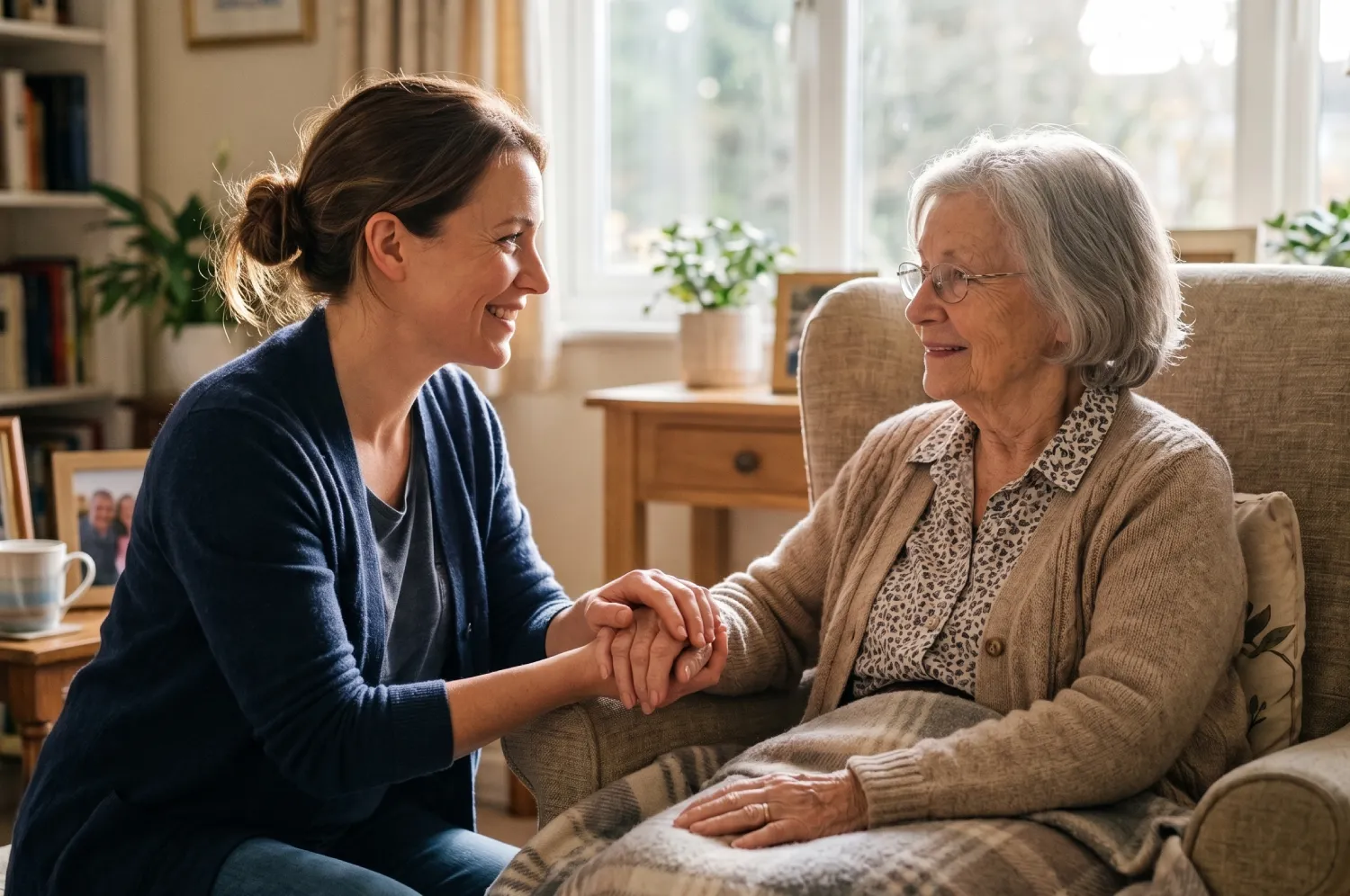
For families caring for loved ones with dementia, one of the biggest challenges is that the disease is largely invisible. When someone uses a walker, we can immediately see that opening a heavy door or navigating stairs may be difficult. Dementia is different. We cannot see the changes occurring inside the brain. Instead, we see their effects: a missed appointment, an unusual decision, difficulty completing a familiar task, or behavior that seems completely out of character.
That distinction matters because when we understand dementia is changing how a person’s brain processes information and interacts with the world, it becomes easier to respond with patience instead of frustration.
What Families Should Understand about Dementia
There are several realities that provide an important foundation for understanding dementia. Dementia involves physical and chemical changes in the brain. Because the brain controls memory, judgment, communication, movement, behavior, and countless everyday functions, damage to the brain can eventually affect nearly every part of a person’s life.
Dementia is also progressive, but progression doesn’t necessarily happen at a steady pace. I often encourage families to picture stairs. A person may experience a decline, remain relatively stable for a period, and then decline again. That’s also why an abrupt change deserves attention. If your loved one’s abilities or behavior suddenly become dramatically different, there may be another factor involved, such as an illness, injury, or change in his or her surroundings.
Another difficult reality is that dementia cannot currently be cured. We can adapt a person’s environment, change how we communicate, and provide support that allows someone to function more successfully. Those interventions can make an enormous difference in quality of life, but they don’t eliminate the underlying disease.
Dementia can ultimately be terminal as well. As the disease progresses, some people die as a direct result of dementia, while others become less able to recover from illnesses and injuries. Understanding these realities helps families make sense of what they may encounter as the disease progresses.
How Dementia Changes Over Time
Dementia is commonly described using three broad stages: mild, moderate, and late. During the mild stage, changes may initially be easy to overlook. Your loved one might have trouble finding words, become confused in a familiar location, or face difficulty with tasks requiring planning and multiple steps. At this stage, your loved one may also be aware that something is changing.
After nearly 30 years of working with people living with dementia, I’ve heard many older adults express fear about someday “losing their mind.” Imagine beginning to notice the very changes you’ve always feared. Someone may minimize his or her difficulties or insist he or she is still completing tasks independently when the rest of the family knows otherwise. It can look like dishonesty, but there may be something deeper happening.
Acknowledging a problem can feel like the first step toward losing control. If other people notice my mistakes, will they take over my finances? Will I still be allowed to drive? Will someone decide where I live? Protecting independence can become extremely important, and that fear can lead to defensiveness.
As dementia progresses into the moderate stage, difficulties become more noticeable in everyday activities. Managing money, preparing food, bathing, dressing, and selecting appropriate clothing may become challenging. In later stages, assistance may eventually be necessary for most aspects of daily living.
Dementia Is a Category, Not a Single Diagnosis
It’s also important to understand what the word “dementia” means. I sometimes use a grocery store comparison. If you’re looking for a cucumber, you go to the produce section. Produce is the category, while the cucumber is the specific item within that category. Dementia works in a similar way. It’s an umbrella term encompassing multiple diseases and conditions.
Alzheimer’s disease is the most commonly diagnosed form. One characteristic associated with Alzheimer’s is difficulty retaining new information. This explains why a person might finish lunch and later insist he or she hasn’t eaten. It can also explain why introducing something new, even something intended to keep the person safe, can be surprisingly difficult.
Consider a walker. After Dad falls, his family understandably decides using a walker will make him safer. But if Dad has Alzheimer’s and has never used one before, using the walker requires his brain to learn something new and remember to apply that information consistently. He might walk away without it or appear not to understand why it’s there.
From the family’s perspective, the solution seems obvious: “Just use the walker.” From Dad’s perspective, however, the new information may not be sticking. Understanding the disease changes how we interpret the behavior.
When Forgetfulness Becomes Something More
People often ask how dementia differs from ordinary forgetfulness. Think about losing your keys. Most of us occasionally put our keys somewhere and forget where we left them. Once we find them, however, we immediately recognize them and know what they’re used for. Someone with Alzheimer’s disease may eventually find the keys but have difficulty understanding their purpose.
For families, functional ability is often an important clue. Instead of focusing only on whether your loved one forgets things, look at what those changes are doing to everyday life. Can your loved one still safely complete familiar routines? Is he or she becoming increasingly dependent on someone else? Are previously manageable tasks now confusing or impossible? Those changes can tell us much more than an isolated memory lapse.
Living with dementia can make it difficult for seniors to manage everyday tasks on their own. Certain age-related conditions can make it more challenging for older adults to age in place safely and comfortably, but experts in 24-hour-home care for Columbus seniors are available around the clock to help aging adults manage their health. Whether your loved one is living with dementia or recovering from a stroke, you can trust the professional caregivers from Assisting Hands Home Care to enhance his or her quality of life.
Why the Type of Dementia Matters
Different forms of dementia can affect people in different ways. Lewy body dementia, for example, may involve movement difficulties, falls, visual disturbances, delusions, and significant fluctuations in functioning. Those fluctuations can be especially confusing because a caregiver might watch someone complete a task independently one day and face significant difficulty with that same task the next. It’s easy to assume the person is refusing, being difficult, or seeking attention, but changes in ability can be part of the disease itself.
Vascular dementia may also involve sudden changes and considerable variation between good and bad days. Frontotemporal dementia can have a particularly significant effect on behavior, impulse control, communication, and the ability to begin or organize tasks. Knowing the diagnosis can help families understand why they’re seeing certain changes and respond more effectively.
Dementia can affect the ability to perform daily chores independently, and you may need to hire a dedicated caregiver to help your loved one manage these tasks. If your senior loved one has been diagnosed with a serious condition and needs help with tasks like meal prep, transportation, bathing, and grooming, reach out to Assisting Hands Home Care, a leading provider of senior home care Columbus families can trust. We also offer comprehensive care for seniors with dementia, Alzheimer’s, and Parkinson’s.
Shift the Question from “What Can’t My Loved One Do?” to “What Can My Loved One Still Do?”
Caregivers understandably pay attention to lost abilities. Mom cannot manage her checking account. Dad cannot safely prepare dinner. Mom cannot choose clothes appropriate for the weather. We need to know those limitations because someone else must compensate for them, but focusing exclusively on limitations can cause us to overlook abilities that remain.
One family told me their mother could no longer dress herself. During winter, they would arrive and find her wearing shorts, flip-flops, and a tank top. When we looked more closely, however, she hadn’t actually lost the physical ability to get dressed. The difficult part was selecting clothing appropriate for the weather.
That meant the solution didn’t necessarily have to be dressing her every morning. Instead, the environment could be changed. Removing out-of-season clothing gave her a closet filled with appropriate choices, allowing her to continue choosing her clothes and dressing herself. The support addressed the part of the task she could no longer manage while preserving the part she still could.
Sometimes the Problem Is Starting the Task
The same principle can apply during meals. A person may sit in front of a plate without eating, leading everyone to assume he or she can no longer feed him or herself. But perhaps the problem isn’t eating. Perhaps there are too many choices or the person no longer knows how to begin.
Removing unnecessary utensils can simplify the situation. Sometimes placing the fork in the person’s hand and assisting with the first bite is enough to get the process started. After that initial cue, he or she may finish the meal independently. The ability itself was still there. What had been lost was the ability to initiate the sequence. Recognizing distinctions like these can preserve independence much longer.
Adapt Before You Take Away
One of my favorite examples involves a woman with early-stage dementia and her microwave. Her microwave had approximately 15 buttons. As dementia progressed, she increasingly pressed the wrong ones. Food overheated and spilled over, and her family understandably began considering unplugging the appliance. That would have prevented those mistakes, but it also would have prevented her from independently heating food.
Then her family tried something different. Because the microwave was black, they used black nail polish to cover the buttons she didn’t need. Instead of having 15 options in front of her, she could see only the three buttons she regularly used. Suddenly, she could operate the microwave again.
Her ability hadn’t completely disappeared. The number of choices had simply become overwhelming. I describe this philosophy as “Substitute, don’t subtract.” Before removing an activity, object, or responsibility entirely, ask whether it can be simplified or adapted. A relatively small environmental change may allow a person with dementia to continue doing something independently.
Never Lose Sight of the Person
As dementia advances, families may watch their loved ones lose the ability to do things that once seemed effortless. Eventually, your loved one may lose speech, mobility, or even the ability to swallow. It can leave families feeling as though the people they knew have disappeared.
My experience has taught me otherwise. Even people with very advanced dementia may respond to a familiar song, a loved one’s voice, gentle touch, or changes in their surroundings. Communication and connection may look different, but different doesn’t mean absent.
For years, I’ve used a simple phrase to describe this: Dementia changes the brain, never the heart.
Good dementia care requires understanding what the disease is taking away. Just as importantly, it requires continuing to recognize the abilities, preferences, and human connection that remain. There’s always a person behind the diagnosis.
Aging in place can present a few challenges for seniors living with dementia. However, they can still live independently at home with the help of professional dementia home care. Columbus families can rely on Assisting Hands Home Care to provide their elderly loved ones with mental and social stimulation, timely medication reminders, assistance with meal prep, and much more. Our caregivers are available around the clock to help your loved one live a happier and healthier life. Call one of our friendly Care Managers today to learn more about our customized care plans.
Want to learn more about dementia and the challenges families face along the journey? Join me for my monthly Real Talk webinar, where I take an in-depth look at a specific dementia-related topic. Click here to learn more and register.